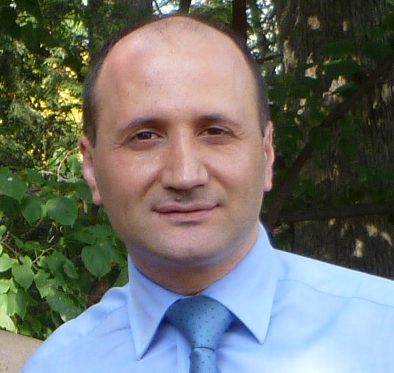
Dr. Youakim Badr is Professor of Data Analytics and Artificial Intelligence at The Pennsylvania State University, Great Valley School of Graduate Professional Studies, where he serves as Professor-in-Charge of the Master of Artificial Intelligence program across Penn State Great Valley and World Campuses. He is also the Founding Director of the Trustworthy Intelligence and Thinking Machine Lab (THINK Lab), a Research Fellow with Penn State’s Center for Socially Responsible Artificial Intelligence and Clinical. He received his Ph.D. in Computer Science from the National Institute of Applied Sciences of Lyon (INSA-Lyon), France, in 2003, and held a tenured faculty appointment at INSA-Lyon before joining Penn State. His research advances trustworthy, secure, scalable, and composable AI systems, with emphasis on agentic AI, AI analytics systems, and trustworthy AI. He has advised and co-advised more than 20 doctoral students, and numerous graduate students internationally and has led or contributed to funded research projects supported by agencies and partners in the United States, France, Europe, and industry. His academic leadership includes designing, launching, and scaling Penn State’s Master of Artificial Intelligence program, developing multiple stackable certificates and graduate AI courses, and expanding interdisciplinary AI pathways in collaboration with programs in data analytics, software engineering, computer science, and business. Dr. Badr has authored or co-authored more than 150+ peer-reviewed publications in leading journals and conferences. He authored Smart Digital Service Ecosystems: A Research Roadmap from Service Computing and Engineering Perspectives with SpringerBriefs, co-edited Springer volumes on emergent Web Intelligence and Digital Transformation. Dr. Badr is the recipient of multiple Penn State awards for research, teaching, innovation, service, and student engagement, as well as national research honors from the French Ministry of Higher Education and Research. He is also a court-appointed scientific expert in artificial intelligence, and a regular expert evaluator for AI and data-intensive systems on national and international funding panels, including the U.S. National Science Foundation (NSF), A*STAR Singapore, NSERC Canada, ANR France, and the EU’s Horizon 2020 CHIST-ERA program. He has also held visiting scholar appointments at Cornell University, The University of Sydney, and CNAM Paris, served in editorial and conference leadership roles, and contributed actively to professional communities including ACM, EDUCAUSE, INFORMS, Linux Foundation AI & Data, and the Agentic AI Foundation. Over the course of his research, Dr. Badr has worked extensively in the area of service computing (distributed systems, interoperable and reusable software components) and information system security to design and deploy self-adaptable connected devices and build secure “service-oriented systems” for the Internet of Things (IoT). In addition, Dr. Badr conducted research activities on the integration of data analytic capabilities and service computing to make service systems smarter from the flood of data generated by connected devices. By leveraging his research activities built around service computing and data analytics, Dr. Badr’s current research strategy aims designing and deploying “Trustworthy AI Service Systems.” He investigates research challenges and business problems from a multidisciplinary and systemic perspectives, focusing on the following research areas: Dr. Badr received several awards In recognition of his scholarship of service and research, in particular:
Biography
Research
1) a risk management framework to evaluate AI cyber-threats, vulnerabilities, and cyber-risks, and develop mitigation strategies, and
2) a blockchain-based federated learning framework and tools to preserve the confidentiality of sensitive data in distributed environments.